Our Research
Commonwealth conducts original qualitative and quantitative research with financially vulnerable people—including Black, Latinx, and women-led households who disproportionately experience financial insecurity. We also interview industry experts and academics. We take what we learn and translate findings into actionable insights and practical solutions designed to change systems to work better for financially vulnerable people. We work with community groups, employers, financial services firms, fintechs, policymakers, and workplace solution providers to design and test real-world, practical solutions that not only work for individuals and families, but are also scalable and address the business needs of our partners.
We share the results of our work to provide you with innovative ideas, practical insights, and the tools you need to act. Explore our publications below.
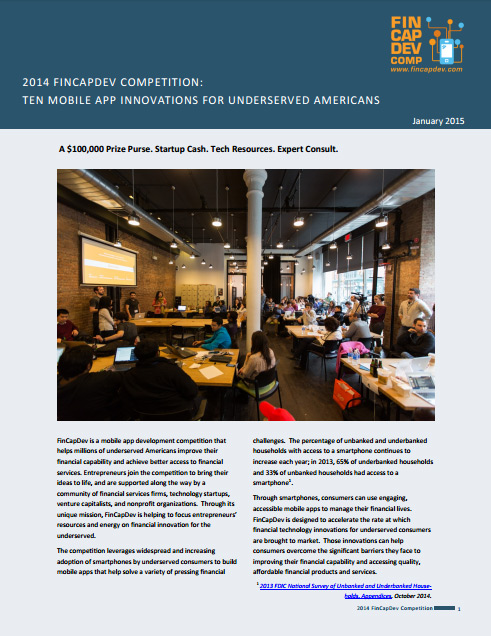
2014 FinCapDev Competition: Ten Mobile App Innovations for Underserved Americans
FinCapDev is a mobile app development competition that helps millions of underserved Americans make smarter financial choices and achieve better access to financial services. This year's competition brought ten new mobile apps directly to the hands of financially vulnerable consumers.
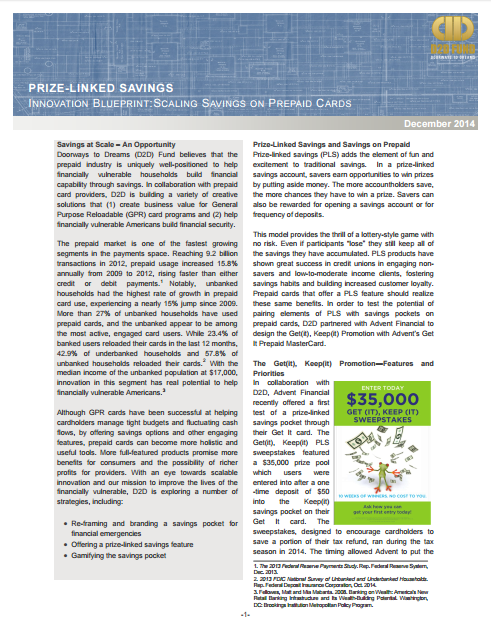
Prize-linked Savings: Scaling Savings on Prepaid Cards
With unbanked households experiencing the highest growth rate in prepaid card use, innovation in the prepaid industry has real potential to help financially vulnerable Americans. D2D (now Commonwealth) is collaborating with prepaid card providers to build scalable, creative solutions to…

Staples and Farm Blitz: The First Ever Financial Wellness at Work Video Game
Financial wellness at work programs are gaining popularity amid growing evidence that financial stress is a significant distraction in the workplace. Recognizing that such programs are most effective when they are offered through a medium with which employees feel comfortable,…

myRA: a New Savings Product for Financially Vulnerable Americans
According to a survey fielded by D2D, consumers have positive initial reactions to a new savings product, myRA, that has been released by the U.S. Treasury Department. myRA is intended to help first-time and small-dollar savers set aside savings directly…

Save to Win 2009-2013
In 2013 Save to Win, the nation's first large-scale prize-linked savings product, expanded to include credit unions in Washington and North Carolina. It also entered its fifth year in Michigan and second in Nebraska. This brief contains full results and…

SaveYourRefund 2014: Saver Stories
Read the stories of tax filers who saved part of their refund during the Save Your Refund 2014 campaign.

Bringing Financial Entertainment to America
Millions of Americans struggle to engage with personal finance concepts, not because they are unimportant, but because doing so feels too tedious and dull to be worth the effort. But it doesn't have to be this way. This infographic looks…

Capital One Student Banking Program: Pilot Testing of Financial Entertainment
D2D (now Commonwealth) has released a report with the results of a pilot studying the role of Financial Entertainment in the classroom. Over 100 students and teachers participated in the pilot, generously supported by Capital One. Students competed in class-wide…

Celebrity Calamity User Interviews
Users of Celebrity Calamity, a Financial Entertainment video game that teaches players about spending and credit card debt, discuss how the game improves their financial capability.

Split Save Win: A Reflection on SaveYourRefund 2014
This paper highlights the approach and successes of Save Your Refund’s second year. The campaign generated a nearly 400% increase in both dollars saved and number of entries while engaging over 75 community tax preparation sites in its efforts. With…