
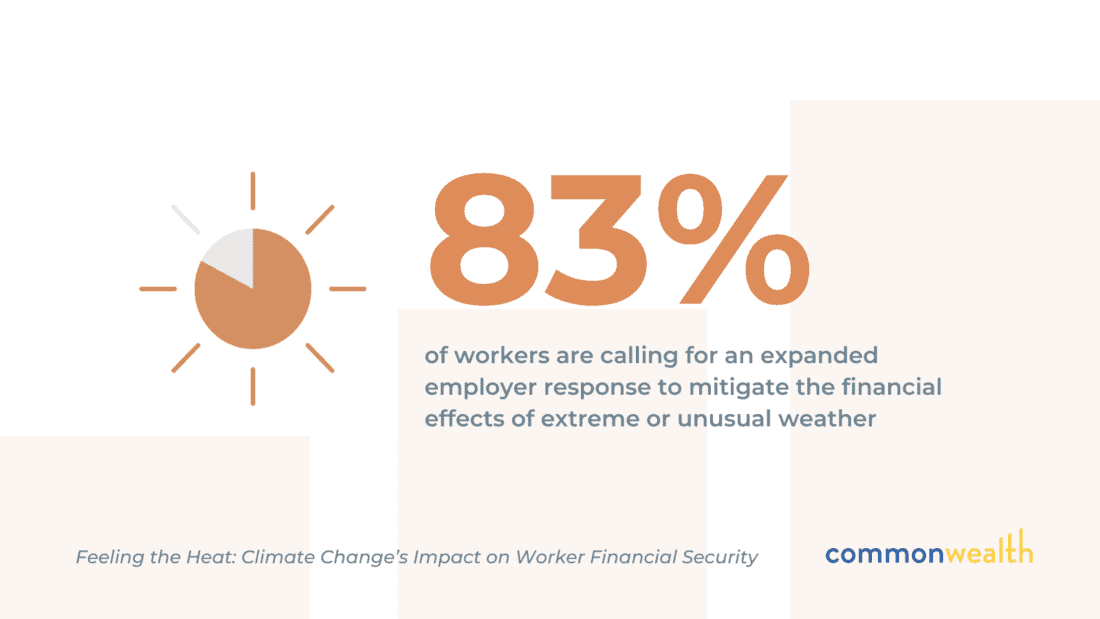
Eighty-three percent of workers report wanting an expanded employer response to mitigate the financial impacts of climate change on U.S. workers.
With relief efforts for Hurricane Helene dominating the news this fall, there was a renewed focus on the role of employers in helping communities through climate-related disasters. According to a Gartner survey, “37% of employers say that workers’ performance was affected following environmental and climate-related risks.” It also highlights how climate change-related employee benefits are among the top offerings HR leaders will need to consider in the next few years. While several companies provide climate-related benefits to address these impacts, these offerings are often focused on the needs of white-collar jobs, with fewer options for workers earning low-to-moderate incomes (LMI). This presents an opportunity for employers to take the lead in tackling the financial impacts of climate change on workers living on LMI by providing climate-related workplace benefits.
How Does Climate Change Impact Workers?
Commonwealth’s survey, Feeling the Heat: Climate Change’s Impact on Worker Financial Security, details the impact of climate change on worker financial security, based on responses from 1,200 U.S. workers earning LMI. The survey reveals that 49% of workers report experiencing negative changes in their work due to extreme or unusual weather. Among respondents who are impacted, 31% say their job was closed, 18% report their hours were reduced, and 11% say they used paid time off. Black and Latin individuals are disproportionately impacted, with 58% of Black workers and 52% of Latin workers experiencing these consequences compared to 46% of white workers.
Building on similar insights, the Aspen Institute explains a domino effect caused by climate change: companies losing work days, businesses owing wages or reducing workers’ income, employees resorting to taking vacation time, or worse, losing their jobs because of an inability to work. The Aspen Institute also underscores a similar yet critical point outlined in Commonwealth’s study: Black and Brown communities are more likely to be impacted.
How Can Employers Tackle the Financial Impacts of Climate Change?
According to Commonwealth survey respondents, employers have a significant role in mitigating the financial effects of climate change. Eighty-three percent of workers report wanting an expanded employer response. Companies have a shared interest in offering policies that can improve employees’ overall well-being. These efforts can potentially yield benefits for employers such as increasing their financial value by implementing climate efforts, as well as attracting, retaining, and increasing satisfaction and morale through policies that offer flexibility. It can also lead to an improvement in productivity and efficiency in hybrid or remote environments.
There is an opportunity for employers to support workers impacted by extreme and unusual weather by exploring these benefits:
- Parametric insurance “covers the probability (or likelihood) of a loss-causing event happening.” This means individuals and businesses will receive payment based on a “covered event” (i.e. hurricane) or certain measurable criteria (i.e. wind speed). There are a few companies like Jumpstart and Recoup Insurance that offer alternative insurance products such as lump sum payments and guaranteed payouts based on geographic location, property damage, and intensity of a natural disaster.
- Climate-related leave policy provides paid leave to workers in case of an extreme weather event. Commonwealth’s research reveals that workers are interested in a paid leave policy (41%) as one of their top interests. Glitch, Inc., a software company, is taking the lead in this area by providing workers with weather-related paid time off.
- Flexible scheduling offers employees the option to work remotely, hybrid, or at flexible times. Commonwealth’s survey respondents are also interested in flexible scheduling (41%) alongside other benefits. Major companies such as Nike, Google, Microsoft, and Delta Airlines have previously incorporated flexible schedules in response to the COVID-19 pandemic.
- Emergency Savings Accounts allow employees to set aside a certain amount of money in case of financial shocks or emergencies. Employers can offer certain options such as automatic enrollment through payroll deductions or contribution matches to incentivize employees. Starbucks recently announced an emergency savings account to help workers manage their finances.
Although wages are important to improving financial security, they are insufficient on their own. Workplace benefits may protect workers against the financial impact of unusual or extreme weather. There is a need for companies, particularly for those employing lower-wage workers, to design benefits that best support their employees impacted by climate-related weather events. These offerings have the potential to provide a safety net for vulnerable workers while also providing business benefits.
Read the full report here and contact Paula Grieco at pgrieco@buildcommonwealth.org to learn how you can work with us on future climate projects.