-
Recent Research
BlackRock’s Emergency Savings Initiative Impact and Learnings Report 2019-2026
Read: BlackRock’s Emergency Savings Initiative Impact and Learnings Report 2019-2026
37%
This risk is widespread: more than 37% of U.S. adults cannot cover a $400 emergency with cash or its equivalent.
Since 2019, Commonwealth has helped advance BlackRock’s Emergency Savings Initiative alongside employers, financial institutions, recordkeepers, researchers, nonprofits, and advocates working to make emergency savings easier to build through the financial systems people already use every day.
Why this matters
Emergency savings is foundational to financial security, yet far too many people in the United States lack liquid funds to cover unexpected expenses.
24% increase
The number of savers now reporting they would draw on their retirement savings in an emergency went up. From 33% in 2020 to 57% now.
The first step
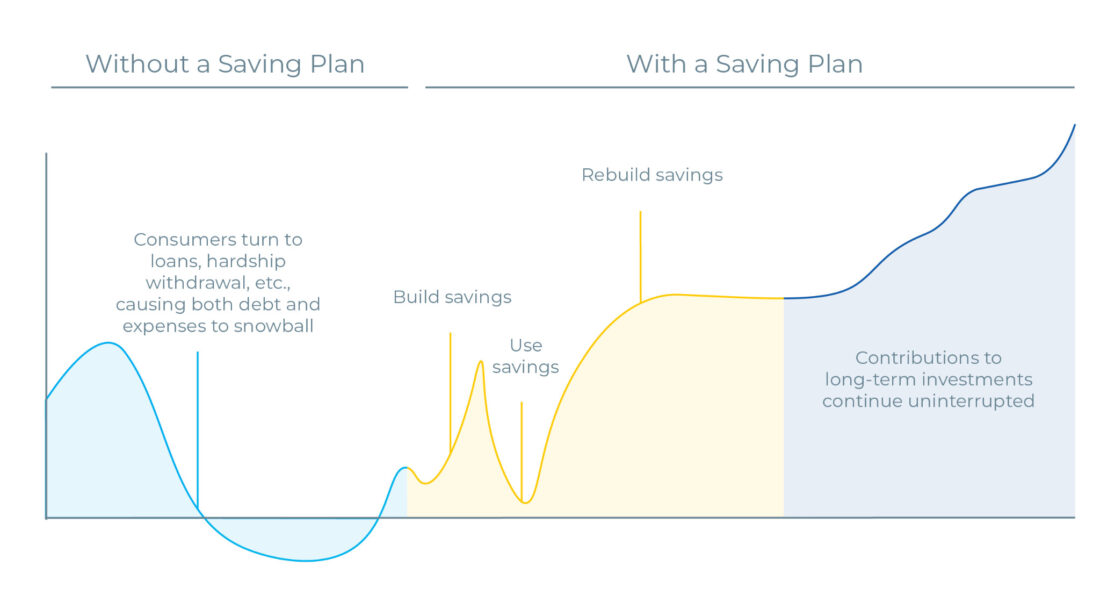
Helping people build emergency savings is a critical first step toward addressing this savings crisis.
Our approach
Commonwealth builds and scales innovative, practical solutions that make it easier for people living on low and moderate incomes to save for emergencies.
To date, Commonwealth has partnered with over 60 leading financial service providers and employers to design and expand access to emergency savings solutions at scale.
Our approach combines rigorous consumer research with real-world pilot testing to understand the emergency savings needs of working people living on low and moderate incomes and to add to the industry body of knowledge.
Not everyone is reached through an employer. With the growth of independent workers or the ‘gig economy’—estimated at 72.9M full- and part-time independent workers, or 43% of the U.S. workforce—new channels are needed to extend access to emergency savings beyond traditional workplace benefits Commonwealth works
$7.9B
To date, the initiative has reached more than 22 million workers nationwide and helped generate over $7.9 billion in new emergency savings, primarily for people living on low and moderate incomes (LMI).*
* Low and moderate income is defined by ESI as those with annual household income of $75,000 or less.
20%
20% of emergency savers who were eligible for their employer’s retirement plan began contributing to a 401(k) for the first time after initiating emergency savings.
$38M
More than 28% of workers who opened an emergency savings account through ESI made a withdrawal (median of $640), suggesting these funds are being used as intended and helping preserve up to $38 million in retirement assets by reducing early plan withdrawals.












See the full list of ESI partners here.
Our Emergency Savings Work
Latest Research & Thinking




News & Events



Take action
Join Our Work
Join a growing network of employers, benefits providers, recordkeepers, fintechs and financial institutions working to make emergency savings more accessible for millions of workers and families. Commonwealth partners with organizations ready to test, scale, and advance innovative solutions to strengthen financial security and retirement readiness, and deliver meaningful impact at scale through BlackRock’s Emergency Savings Initiative (ESI).
About BlackRock’s Emergency Savings Initiative
Guided by BlackRock’s purpose to help more and more people experience financial well-being, The BlackRock Foundation funds and partners with organizations that strengthen financial security by helping people earn, save and invest—earlier, more often and for their futures. BlackRock’s Emergency Savings Initiative is made possible through philanthropic support from The BlackRock Foundation. The initiative brings together partner companies and nonprofit financial health experts to make saving easier and more accessible for people living on low and moderate incomes. For more information, visit: blackrock.com/corporate/aboutus/social-impact
Disclaimer: BlackRock’s support of ESI was provided through grants from The BlackRock Foundation. The public policy activities described on this page were carried out by ESI partners, and The BlackRock Foundation does not engage in lobbying activities or earmark its grant funds for use in lobbying activities. Similarly, Commonwealth does not engage in lobbying activities, but rather engages in a series of discussions alongside policy experts to evaluate the current emergency savings policy landscape.