UPDATE: Auto-enrollment for 530A (Trump) Accounts changes what comes next for families
As of October 1, eligible children will be automatically enrolled in 530A (Trump) Accounts. Families still need to take action to claim their child’s account and to make an election for the $1,000 pilot program contribution.
As 530A (Trump) Accounts roll out nationally, parents, employers, financial coaches, tax preparers, and community organizations are navigating a new set of questions:

What information do families need in order to make informed decisions for their children?

How should these accounts be presented to parents living on low and moderate incomes (LMI)?1
How do organizations communicate about a program that may carry political associations for some families?
Mapping the Opportunity for Families Living on LMI
14.4M
Projection of children across income levels born in the U.S. between 2025 and 2028 who may qualify for the $1,000 federal seed funding.
5.8M
Children from families living on LMI who may qualify for the $1,000 seed funding.2
$2.88B
Federal seed dollars that children living on LMI are at risk of missing out on during the life of the pilot.3
$3,000
The amount the initial seed fund could reach by the time the child turns 18.4
$44,000
The amount the initial seed fund could reach by the time the child enters retirement (age 65).5
Investor Identity
Participating in capital markets builds confidence, cultivates a sense of investor identity, and supports financial security.
Our Research

Commonwealth, through generous support from the Vanguard Foundation and the Gitlab Foundation, conducted research with parents, financial coaches, community organizations, and other trusted intermediaries.
The findings reveal a consistent theme: interest in the opportunity is high, but participation will ultimately be shaped by trust, clarity, and access to reliable information.
This research includes findings to the questions listed above and offers practical guidance for organizations communicating with families about 530A (Trump) Accounts. The accounts also represent something larger than a new investment vehicle. For many families, particularly those living on LMI, they may provide an early opportunity to build investor identity, which is a key component to accessing capital markets identified in our previous research as part of our inclusive investing work. Investor identity is defined as a sense of confidence, belonging, and familiarity that helps individuals see themselves as participants in capital markets.
Without intentional outreach and trusted communication, families risk missing not only the initial federal seed, but future opportunities from employer, philanthropic, and private-sector contributions as the ecosystem evolves.
Incentives, Branding, and Communicators
Across parent and expert interviews, focus groups, and message testing, several consistent themes emerged around trust, clarity, branding, and financial opportunity. Our research identified four major themes shaping how families and intermediaries view 530A (Trump) Accounts.
1.
The opportunity is compelling.
- The $1,000 federal seed contribution and long-term wealth-building potential were highly appealing to many parents.
- The opportunity itself is broadly compelling, particularly when financial professionals presented the accounts as a complement to existing child investment plans. The seed funding aspect universally drives sign-up intent.
2.
Information gaps create uncertainty and slow participation.
- Families often lacked clear information about how the accounts work logistically, how they fit alongside other investment accounts, and whether the accounts would continue into the future through administration changes.
- Organizations and advisors must be prepared to explain how the accounts work, where they fit alongside other child savings and investing products, and why the accounts are credible and secure. Messaging should emphasize long-term investing, simple and accessible language, and the opportunity to “start your child with something.”
3.
The branding of the name “Trump” Accounts creates a barrier for many families living on LMI.
- The “Trump” name was polarizing for some parents and organizations, who expressed hesitation, mistrust, or fears of alignment with personal values.
- Neutral, transparent language is critical. Organizations should focus on the benefits of the accounts—including federal and philanthropic seed funding and long-term wealth-building potential—while using both “530A” and “Trump” together to clearly identify the accounts without leaning into political branding.
4.
Trusted communicators can help close the gap.
- Parents were likely to learn about the accounts through informal or community-based channels and then complete their own research online and on social media after hearing about the new accounts.
- Building trust will require on-the-ground partnerships with individuals (teachers, nurses, financial professionals), employers, and community organizations that can answer questions over time.
What Families Are Feeling

If my employer sent an email about it, it would make it more legit—the company would be endorsing it.”
DAVID*, Parent, Research Participant

Is this going to go away with the next administration? Just because it is tied to his name. He’s not going to be president forever—how does that work?”
AMANDA*, Parent, Research Participant

I’ve never even heard of it being referred to as, like, 530A account. I’ve just heard… ‘Trump’ Account. The name could include more things to indicate it is for children being born.”
AMAYA*, Parent, Research Participant
All the advertisements around these accounts are kind of vague. People really need to get information on what it is and how it can be beneficial.”
DAVID*, Parent, Research Participant
Messaging Recommendations
Several consistent recommendations about messaging emerged across the body of research:

Parents preferred transparent, neutral language that used both “530A” and “Trump” together, rather than avoiding the “Trump” branding entirely.

The term “investing account” resonated more strongly than “savings account,” signaling long-term growth and opportunity.

Messaging centered on helping children “get started” financially tested more positively than messaging narrowly focused on retirement or college savings.
Parents desired straightforward explanations about legitimacy, the government’s role, penalties, flexibility of use, and how the accounts compare to 529s and other Child Savings Accounts.

Awareness and action were often driven by different sources. Parents frequently learned about the accounts through peer networks, social media, and other informal channels, but looked to professionals and organizations as formal trusted communicators for clarification, validation, and guidance when evaluating the opportunity.

Culturally responsive materials and clear financial terminology for families with language barriers or limited investing familiarity were top of mind from community organizations and experts.
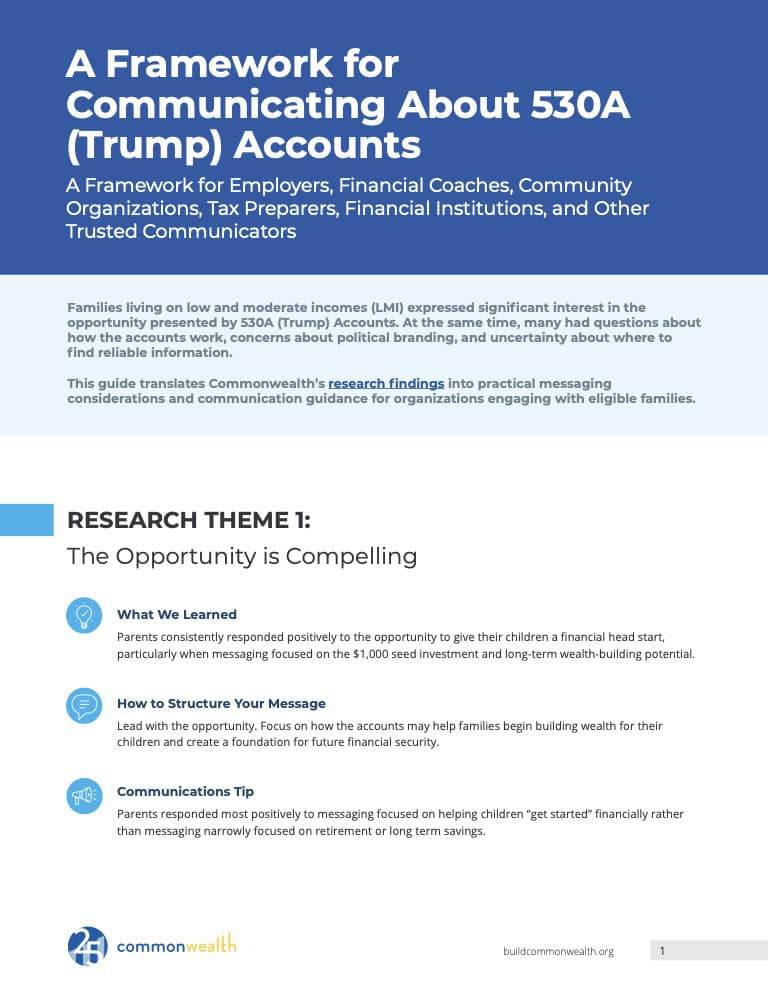
To support implementation of these themes, Commonwealth developed a companion messaging framework flyer with practical messaging guidance and outreach resources.
Ready-to-Use Messaging
The following language reflects messaging that tested positively with families and financial experts in Commonwealth’s initial research. Copy, customize, and adapt these examples to reflect your organization’s brand voice, audience, and communication channels while maintaining the factual information and research-informed
messaging principles outlined above.
MESSAGE 1: INTRODUCING 530A (TRUMP) ACCOUNTS
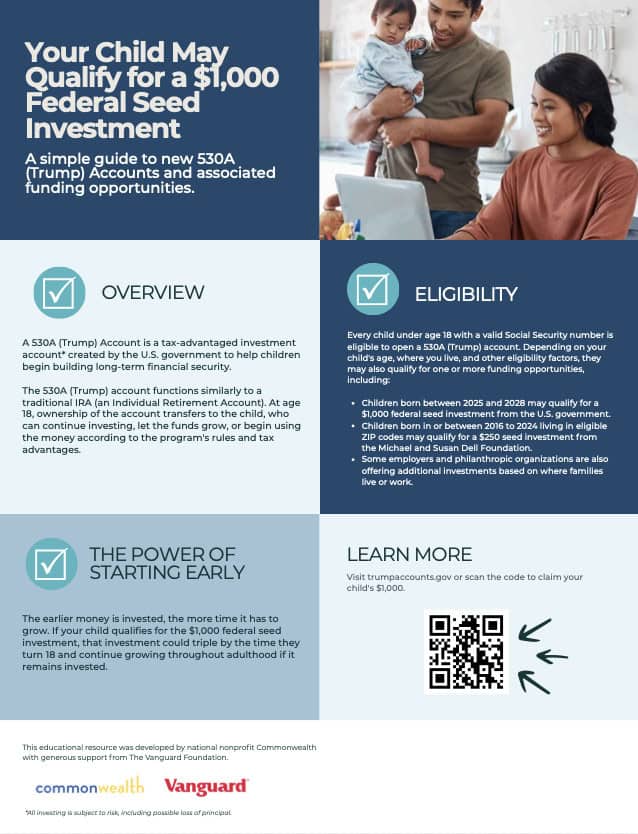
Opening a 530A (Trump) Account today could give your child a jump start on building savings. If your child is a U.S. citizen with a social security number and was born between 2025 and 2028, the U.S. government will deposit $1,000 into your child’s 530A (Trump) Account. If you have an older child who doesn’t qualify for the federal funding, you might still be eligible for additional money from your employer or philanthropic organizations now or in the future. This means that signing up for all your children today could mean further contributions from outside sources later.
MESSAGE 2: EXPLAINING 530A (TRUMP) ACCOUNTS
The unique advantages of opening a 530A (Trump) Account include:
- Babies born between 2025 and 2028 are eligible for a $1,000 seed funded by the U.S. government.
- Additional funding from employers and philanthropic organizations continues to be announced for children of all ages.
- Early investing is one of the most powerful tools a family can use to support a child’s future, offering an opportunity for funds to grow over time while helping build confidence and familiarity with investing.
MESSAGE 3: KEEPING YOUR MESSAGE NEUTRAL
The 530A (Trump) Account is a tax-advantaged investing account (similar to a traditional IRA). At age 18, ownership of the account transfers to the child, who can continue investing, allow the funds to grow, or begin utilizing the account consistent with program rules and tax advantages. Every child with a social security number under the age of 18 is eligible to open an account. Children born between 2025 and 2028 may qualify for $1,000 from the U.S. government, and employers and foundations are offering some additional investments, depending on where you work, where you live, and how old your child is.
MESSAGE 4: BUILDING TRUST
If you’ve heard about 530A (Trump) Accounts and are looking for more information, we can help explain how the accounts work, answer common questions, and connect you with additional resources about the accounts.

If my employer sent an email about it, it would make it more legit—the company would be endorsing it.”
GILLES HUDELOT, MS-PFP, CFP®, AFC® Financial Expert and Chairman of the AFCPE Government Relations Task Force
The Role of Communicators
The research suggests that the primary barrier to participation is not lack of interest, but lack of clarity and confidence. Organizations can effectively reach eligible families by developing messages that address their needs and leverage these messages with trusted communicators.
The themes also suggest that trust in the communicator matters as much as the message itself. Different families trusted different entry points, with some responding more positively to community organizations and others placing greater trust in financial institutions or employers.
Organizations identified strong opportunities for outreach through tax preparation environments, workplace communications, school districts, financial coaching sessions, pediatric and hospital systems, and multilingual community-based outreach.
When asked, how did you find out about 530A (Trump) Accounts?

A sister in law.”
RENEE*, Parent, Research Participant

I actually heard about it on the TV, which feels very old school.”
ISABELLA*, Parent, Research Participant

I researched it for probably 2–3 weeks before making a decision.”
DAN*, Parent, Research Participant

A podcast. Watched a video or two on YouTube. Not extremely educated.”
ZOE*, Parent, Research Participant
Frequently Asked Questions
You can sign your child up for an account by filing the IRS 4547 form with your taxes, or through the official website. You will need to provide your child’s name, date of birth, social security number and other information (Source: Trump account website, IRS).
After you sign your child up for an account, you’ll receive an email prompting you to open the official 530A (Trump) Account app (Source: Trump account website).
The account is meant to build long-term savings similar to a traditional IRA, but there are special rules during the growth period (i.e. account opening until January 1st of the calendar year the child turns 18) for eligible investments, contribution limits, and distribution limits. After the growth period, the rules governing traditional IRAs generally apply (Source: Trump account website, IRS).
Takeaways
Families living on LMI were broadly interested in the opportunity presented by 530A (Trump) Accounts, but the research suggests that participation will be shaped less by interest alone and more by trust, clarity, and access to reliable information. Trusted communicators, including employers, financial coaches, tax preparers, educators, healthcare providers, and community organizations, have an important role to play in helping families navigate this new and evolving opportunity.
As the program develops and additional employer and philanthropic contributions emerge, 530A (Trump) Accounts have the potential to expand access to investing, strengthen investor identity, and support long-term wealth building for future generations.

I see it more as, like, saving enough for a stepping stone on a launching pad for [my children].”
DAN*, Parent, Research Participant
Investor Identity
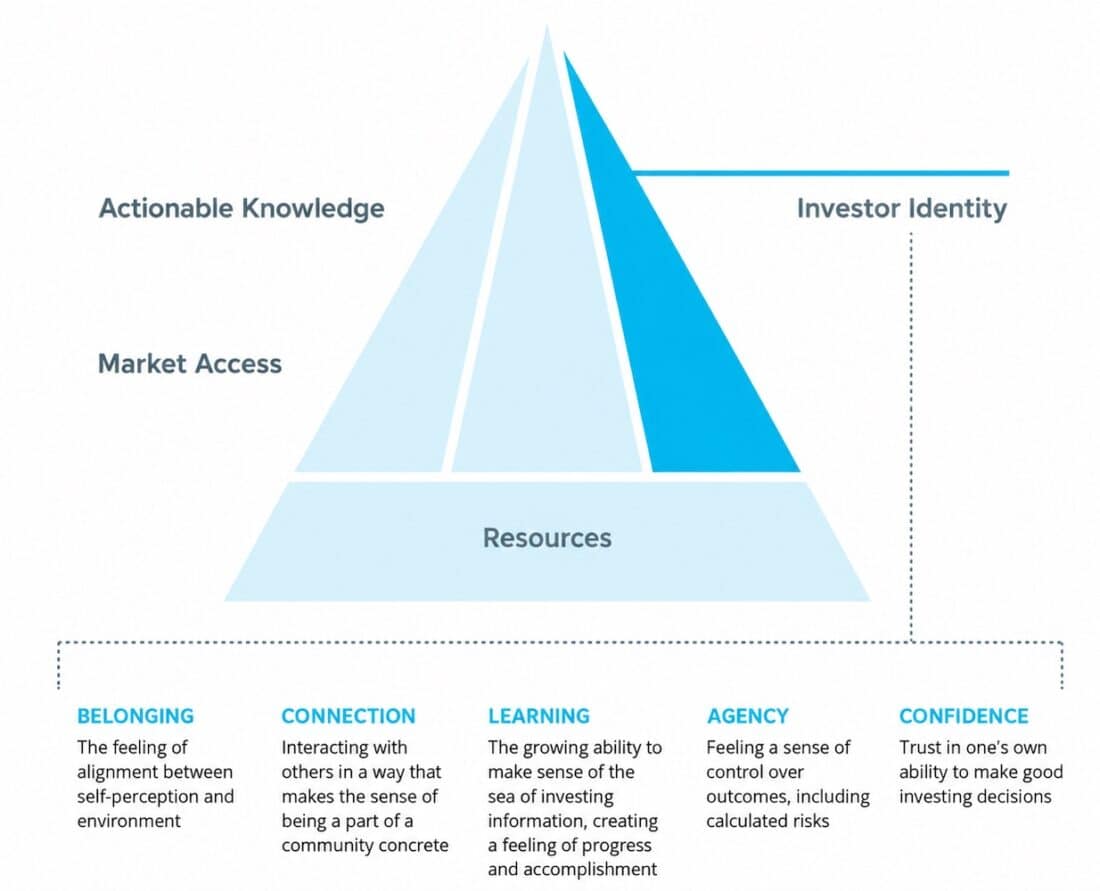
“Investor identity” is a sense of belonging within the broader investing community that is critical for attracting and retaining beginner investors living on LMI. An earlier Commonwealth national research initiative advanced the importance of developing investor identity to create a more inclusive investing ecosystem. This work aimed to address the barriers that keep many individuals living on LMI from seeing themselves as investors.
Future Research
Building on these findings, Commonwealth will continue to study how eligible families learn about, evaluate, and enroll in 530A (Trump) Accounts. Through two upcoming AI-driven conversational surveys with eligible parents, we will gather additional insights on awareness, understanding, messaging effectiveness, and barriers to participation. This next phase of research will help refine communication strategies and identify opportunities to better support families in accessing the accounts.
Commonwealth is actively seeking organizations interested in partnering on this research now and in the future. In particular, we aim to expand partnerships to pilot and scale strategies, conduct additional research, and participate in future conversations and webinars. To learn more and become a project partner, we invite you to connect with us at info@buildcommonwealth.org.
You can also sign up for our newsletter to keep track of innovative research and future insights to sustain future generations of investors.
Acknowledgements
This report was made possible by the generous support of the Vanguard Foundation and the Gitlab Foundation.
We would also like to thank the parents, community organizations, financial coaches, counselors, practitioners, and subject matter experts who generously shared their time, perspectives, and lived experiences throughout this research. Their insights helped shape our understanding of how families perceive, evaluate, and engage with 530A (Trump) Accounts, and informed the themes and recommendations included in this brief.
Thank you to Commonwealth staff members Emily Bergman, Charles de la Cruz, Katia Diaz, Anahit Fitzpatrick, Paula Grieco, Amelia Simons, and Teresa Willand who made this report possible.

Founded in 2001, Commonwealth is a national nonprofit celebrating 25 years of building financial security and opportunity for low and moderate income households through innovation and partnerships. For a quarter of a century, Commonwealth has designed effective innovations, products, and policies enabling nearly 2.5 million people to save nearly $9 billion. Commonwealth collaborates with consumers, the financial services industry, employers, and policymakers. Because Black, Latin, and women-led households disproportionately experience financial insecurity, we focus especially on these populations. The solutions we build are grounded in real life, based on our deep understanding of people living on low and moderate incomes and how businesses can best serve them. To learn more, visit us at www.buildcommonwealth.org.
Founded in 1975, Vanguard is one of the world’s leading investment management companies. The firm offers investments, advice, and retirement services to tens of millions of individual investors around the globe—directly, through workplace plans, and through financial intermediaries. Vanguard operates under a unique, investor-owned structure where Vanguard fund shareholders own the funds, which in turn own Vanguard. As such, Vanguard adheres to a simple purpose: To take a stand for all investors, to treat them fairly, and to give them the best chance for investment success. For more information, visit vanguard.com.

GitLab Foundation is committed to improving lifetime earnings through access to opportunities. Founded in 2022, the Foundation provides innovative organizations with capital and capacity building to help people achieve economic mobility in the United States, Colombia, and Kenya. With an ambitious goal of generating at least $100 in additional lifetime earnings for every $1 invested, GitLab Foundation backs solutions with the real potential to transform lives and unlock opportunity at scale. To date, we estimate our investments will generate more than $34.7 billion in increased lifetime earnings. Learn more at https://www.gitlabfoundation.org.
*All parent research participant names have been changed for anonymity.
- Households living on low and moderate incomes is defined as families and individuals who earn $30,000-$80,000 per year. ↩︎
- Assuming 40% of eligible children are born to households earning LMI ↩︎
- Based on historical EITC take-up rates, an estimated 20% of eligible babies are projected not to claim their $1,000 seed deposit. ↩︎
- A child who receives the $1,000 in this account at birth could start adulthood with nearly $3,000. ↩︎
- A child who receives the $1,000 in this account at birth could reach retirement (age 65) with over $44,000 invested (assuming modest 6% returns), even if no other deposits are made to the account. ↩︎