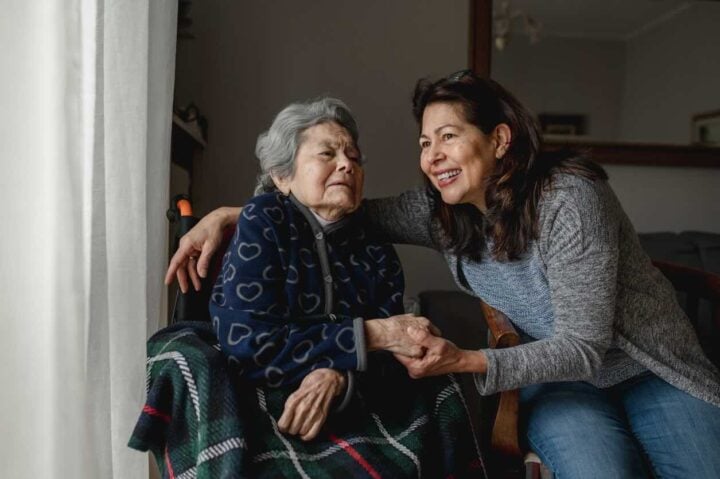
Ten thousand people turn 65 every day in the U.S. as Baby Boomers age into retirement and the next chapters of their lives. The Administration for Community Living (ACL) estimates that “someone turning age 65 today has almost a 70% chance of needing some type of long-term care services and supports in their remaining years.” For many, a significant part of that care and support will come from family or friends acting as unpaid caregivers. Approximately 49 million Americans are providing unpaid care for someone over the age of 50 already.
78% of them manage regular, out-of-pocket caregiving costs that average 26% of their income. When disaggregated by race/ethnicity, average caregiving costs comprise a relatively high share of African American and Hispanic/Latino caregivers’ incomes (34% and 47% respectively) and a relatively lower share of Asian American/Pacific Islander and white caregivers’ incomes (22% and 18% respectively) compared to the overall average. The financial impacts of unpaid caregiving are felt differently across groups but nevertheless pose widespread and growing challenges on all households across the country, with few products or programs available to support them.
Now is the time to bridge the large gap between the rapidly increasing senior population and the minimal financial support for the unpaid caregivers who take care of them—particularly for caregivers living on low-to-moderate incomes (LMI) (i.e., incomes between $30,000 and $80,000 per year). In order to develop solutions for this growing challenge, Commonwealth has launched a new initiative, funded by The Prudential Foundation, to study the needs of unpaid elder caregivers earning LMI, design innovative product concepts that will support their financial health as they care for elderly family members and friends, and collaborate with partners to build and implement these concepts. The capital markets infrastructure is already robust in the U.S., but it does not specifically support the unique needs of elder caregivers. We believe that financial service providers and investment firms are uniquely positioned to join this initiative and partner to develop much-needed solutions for elder caregivers.
Our recent national survey provided critical insights about the financial role and preparedness of current and prospective elder caregivers that will serve as the basis for developing these new financial products. The majority of survey respondents were women who were 50 years old or older, which is in line with nationwide caregiver trends.
Key Findings

54% of caregivers and 62% of future caregivers are or anticipate they will be the sole supporter for an elderly loved one.
$1,000-$5,000
33% of current elder caregivers and 28% of future elder caregivers estimate spending between $1,000 and $5,000 out of pocket on caregiving expenses annually.
$5,000+
Another 23% of current elder caregivers and 25% of future elder caregivers estimate annual expenses exceeding $5,000.
Elder caregivers’ top caregiving expenses included:

53% Food

37% Housing

35% Transportation

35% Household items
The top three financial impacts experienced by elder caregivers were:

32% Reducing discretionary spending

30% No longer being able to save

29% Passing up promotions at work
With the valuable insights gained from survey participants and comprehensive landscape analysis, we’re learning how people are managing the financial uncertainties of elder caregiving and identifying opportunities for innovative products to support them. We aim to design new options for LMI-earning elder caregivers beyond reducing discretionary spending or discontinuing saving to manage the financial impacts of providing care. A joint report by the National Alliance for Caregiving and AARP found that caregiving lasts approximately 5.5 years, with nearly three out of ten caregivers providing care for over five years. Commonwealth’s research has found that elder caregiving over a four- to five-year period costs $20,000-$25,000. These data and insights are critical to developing financial products tailored towards the needs of unpaid elder caregivers and provide tools for them to plan ahead, build up their reserves for future caregiving, and protect their own financial health and well-being along the way.
As caregiving continues to be on the rise, Commonwealth is here to support the advancement of research-informed, innovative products and solutions that support the financial health and well-being of unpaid elder caregivers living on LMI. We invite you to join us in supporting this initiative because a future where elder caregivers are more financially sound is a win-win for both caregivers and elder care recipients alike. Learn more by:
- Signing up for updates about this work.
- Discuss ways to partner with us to bring new, innovative products and solutions aimed at improving the financial health of caregivers.