
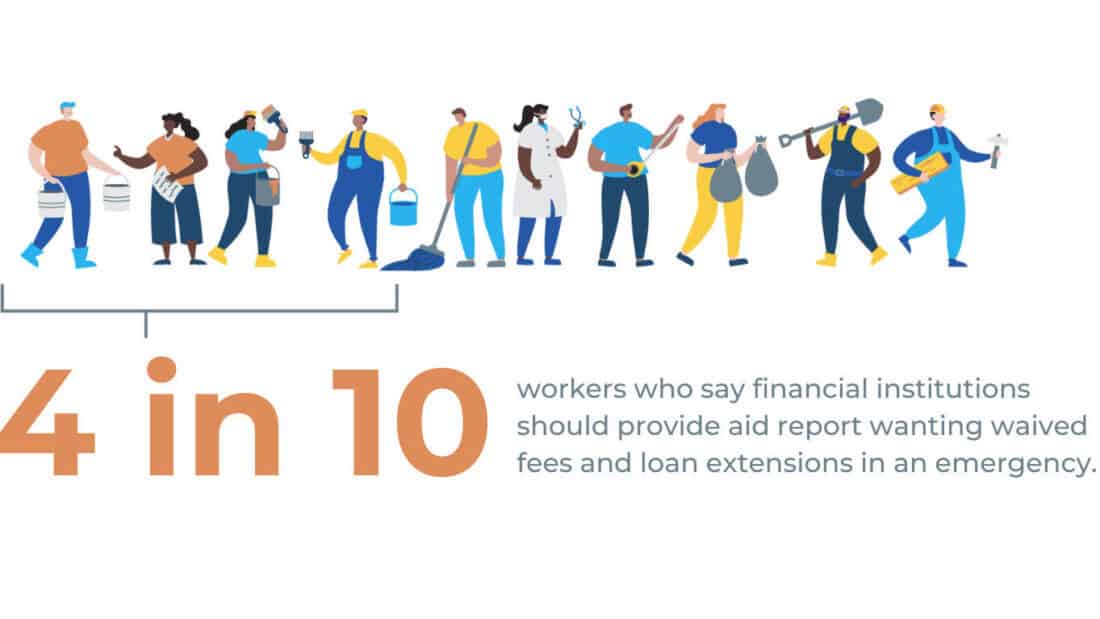
Four in ten workers who say financial institutions should provide aid report wanting waived fees and loan extensions in an emergency.
In the first few months of 2025, the U.S. experienced devastating wildfires, flooding, and tornadoes leading to billions of dollars of destruction. In addition to having a deadly impact on individual lives, households, and businesses, there are also impacts on the financial services industry—including higher loan defaults, credit losses, and more. Overall, property damage from environmental factors threatens a total of $2.4 billion across nearly 200 national banks.
It is crucial for financial institutions to help consumers with low to moderate incomes (LMI) who are impacted by extreme weather, especially with clear interest from workers for the financial sector to do so. According to Commonwealth’s survey, 23% of respondents report that financial institutions should be providing aid to workers impacted by extreme weather. Among this group of respondents, four in ten report wanting waived fees and loan extensions in an emergency.
How is Climate Change Impacting Financial Institutions?
According to the Center for American Progress, “physical risks” caused by climate-related weather results in certain types of institutions experiencing more losses. This includes: insurance companies, banks, other financial intermediaries, mortgage, commercial real estate, business, and agricultural loans. The U.S. Department of Treasury further outlines how “climate hazards” can impact “households’ ability to manage losses, expenses, and transactions using financial products and services such as credit, insurance, and payments.” These are primarily due to:
- Households that are unable to access cash because of physical damages that interrupt banks and firms’ operations, making it difficult to make transactions.
- Home insurance providers that are choosing to either increase household premiums, decrease or not renew coverage because of growing claims in certain areas; and
- More households that are acquiring debt because individuals are using credit to manage expenses, especially if they have limited savings or are waiting for relief payments. These actions can lead to delinquencies and forbearances.
How Can Financial Institutions Tackle the Financial Impact of Climate Change?
Banks and financial services companies are in a unique position to address the financial impacts of extreme weather, being among the first to respond during major disasters, often deploying critical resources. This role fosters goodwill within the communities they serve. Supporting consumers during a crisis also comes with business benefits, with companies offering climate-related products and services seeing improvement in their financial stability and customer retention.
Financial institutions can play an even more integral role in mitigating the financial impacts of weather-related events. Banks and financial services firms can support consumers impacted by exploring products and services that meet their needs including:
- Waiving account fees or late fees which can minimize any additional financial stress incurred by consumers while also ensuring their credit score is preserved. According to previously unpublished data found in Commonwealth’s survey, 41% of workers say they are interested in financial institutions’ offering waived account fees or late fees. JPMorganChase is a prime example of a company utilizing these services in times of need. During Hurricane Irene, the company waived fees for customers in 13 states who made late payments on credit cards or loans.
- Extending loan payments can help borrowers “manage their loan debt, ease cash-flow pressures, and improve their capacity to service debt.” This in turn helps financial institutions collect loans. Commonwealth survey respondents also listed extending loan payments (41%) as a valuable resource. Companies like Umpuqua Bank are leading the way in this area by implementing a disaster forbearance program for homeowners to pause their mortgage payments for a certain period.
- Offering parametric Insurance which “covers the probability (or likelihood) of a loss-causing event happening.” As previously mentioned, individuals and businesses will receive guaranteed flat-rate payment (usually $10,000 for individuals, $100,000 for businesses) based on a “covered event” (i.e., hurricane) or certain measurable criteria (i.e., wind speed). Insurers can deploy parametric insurance faster since this process allows for money to reach policyholders without the need for claims adjustments. It can also complement or fill in the gaps of traditional coverage expenses. There has been a growing interest in parametric insurance over the past two years. The most recent development has been companies such as Aon and Swiss Re partnering to provide a parametric insurance product to mitigate losses from hurricanes in the U.S.
Workers living on LMI are interested in financial institutions supporting them in times of crisis. However, a new shift in the political landscape is prompting questions on whether to decrease financial institutions’ involvement in climate initiatives. Amidst the uncertainty, banks and financial services firms can explore opportunities to support consumers by providing products and services such as extended loan payments, waiving fees, and parametric insurance that can cushion financial shocks during and after a weather event. These services can ultimately alleviate debt burdens, ensure consumers can get back on their feet, and build trust among their customers and communities.
Read the full report here and contact Paula Grieco at pgrieco@buildcommonwealth.org to learn how you can partner with us on future climate projects.